
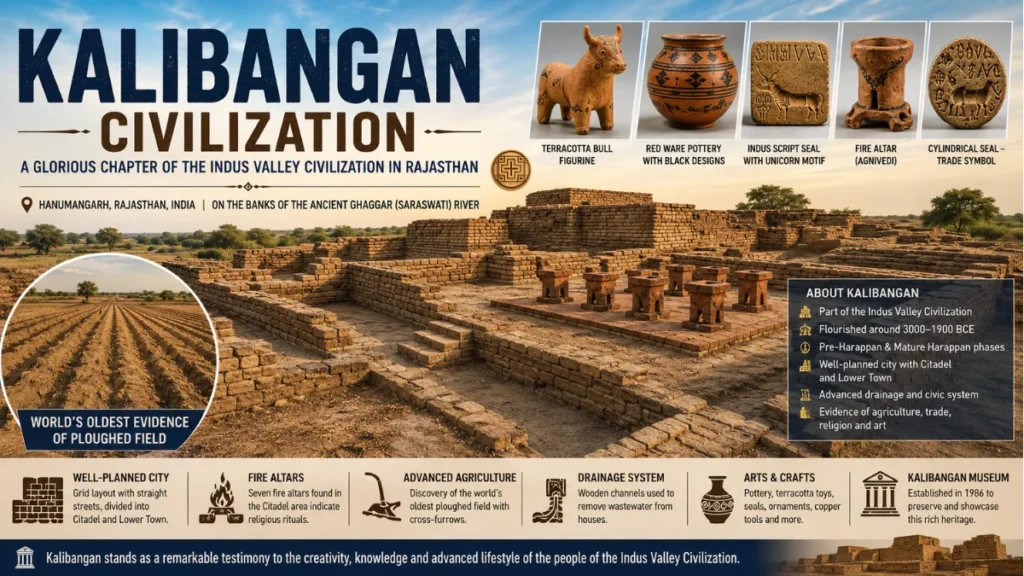
Kalibangan Civilization Reveals the Deep Roots of Rajasthan’s Ancient Past
History of Kalibangan: The history of Rajasthan is often associated with majestic forts, Rajput kingdoms, and legendary tales of bravery. Yet, long before the rise of medieval dynasties, this region was already home to some of the earliest organized human settlements in the Indian subcontinent. Among the most remarkable archaeological discoveries connected to this ancient heritage is Kalibangan, one of the most important urban centers linked to the Indus Valley Civilization.
Situated along the banks of the Ghaggar River in present-day Hanumangarh district of Rajasthan, Kalibangan offers rare insight into life nearly five thousand years ago. Excavations at the site revealed evidence of planned cities, advanced farming techniques, religious rituals, drainage systems, and trade networks. Archaeologists also uncovered what is considered one of the world’s oldest ploughed agricultural fields, making the site especially important for understanding the origins of organized agriculture in South Asia.
The history of Kalibangan is not merely the story of an archaeological site. It is a story about the growth of human civilization, the development of urban culture, and the remarkable ability of ancient societies to organize complex communities long before modern technology existed.
Rajasthan’s Ancient Historical Background
To understand the significance of Kalibangan, it is important to look at the broader timeline of Rajasthan’s ancient history. Archaeological discoveries across the state suggest that human activity in this region dates back hundreds of thousands of years. Stone tools, cave shelters, copper artifacts, and urban settlements together reveal a long journey of cultural and technological progress.
Historians generally divide Rajasthan’s ancient past into three broad historical phases:
| Historical Period | Approximate Timeline | Major Characteristics |
|---|---|---|
| Prehistoric Age | 2.5 million BCE – 3000 BCE | Stone Age cultures and early human life |
| Protohistoric Age | 3000 BCE – 600 BCE | Indus Valley Civilization and Vedic culture |
| Historic Age | After 600 BCE | Rise of kingdoms and written records |
Archaeological surveys in Rajasthan began during the nineteenth century. One of the earliest documented surveys was carried out in 1871 by A.C.L. Carlleyle, who studied prehistoric remains in the region. These early explorations laid the foundation for later discoveries such as Kalibangan.
Stone Age Cultures in Rajasthan
Paleolithic Period: Early Human Survival
The Paleolithic or Old Stone Age marks the earliest stage of human life in Rajasthan. During this time, people depended on hunting and gathering for survival. Large stone tools such as hand axes were commonly used.
Several important Paleolithic sites have been identified in Rajasthan, including areas near Jaipur, Indergarh, Bharatpur, Jalore, and Jhalawar. Archaeologists discovered stone tools, rock shelters, and other evidence that indicates the presence of early human communities.
Life during this period was simple and heavily dependent on nature. Humans lived in caves or temporary shelters and moved frequently in search of food and water.
Mesolithic Period: Signs of Social Development
The Mesolithic Age witnessed gradual improvements in human life. Smaller stone tools known as microliths became common, and communities began experimenting with animal domestication.
Sites such as Bagor in Bhilwara and Tilwara in Barmer are considered highly important because they provide some of the earliest evidence of animal husbandry in Rajasthan.
Researchers believe that people during this phase started living in semi-permanent settlements. Hunting remained important, but the domestication of animals marked the beginning of a more organized lifestyle.
Neolithic Period: The Agricultural Revolution
The Neolithic Age transformed human civilization. Communities shifted from hunting and gathering toward farming and settled life.
Major developments during this era included:
- Beginning of agriculture
- Domestication of animals
- Development of pottery
- Construction of permanent houses
- Emergence of village communities
This agricultural transition laid the foundation for later urban civilizations such as the Indus Valley Civilization, of which Kalibangan became a significant part.
Chalcolithic and Iron Age Rajasthan
Chalcolithic Period
The Chalcolithic Age, also known as the Copper-Stone Age, saw the use of both stone and copper tools. Rajasthan became an important center for copper production and trade.
One of the most notable Chalcolithic settlements was Ganeshwar in present-day Sikar district. Archaeologists discovered large quantities of copper objects at the site, including tools and weapons.
Some historians have described Ganeshwar as one of the earliest copper-producing cultures in India. These discoveries demonstrate that Rajasthan played a major role in the development of metallurgy.
Iron Age
The Iron Age marked another major technological advancement. Iron tools improved agriculture, construction, and warfare.
Important Iron Age sites in Rajasthan include:
- Noh in Bharatpur
- Jodhpura near Jaipur
- Sunari in Jhunjhunu
Evidence of furnaces and metal-smelting activities indicates that ancient Rajasthan possessed advanced metallurgical knowledge.
History of Kalibangan: Discovery and Excavation
Discovery of Kalibangan
The modern history of Kalibangan began in the twentieth century. Although the area had attracted scholarly attention earlier, the site gained major recognition after archaeologist Amalananda Ghosh identified it in 1952.
Kalibangan is located near the dried bed of the Ghaggar River, which many scholars associate with the ancient Saraswati River mentioned in early Indian texts.
Before Ghosh’s work, Italian scholar Luigi Pio Tessitori had also referred to archaeological remains in the region during the early twentieth century. However, systematic exploration came later.
The discovery of Kalibangan was highly significant because it expanded the known geographical reach of the Indus Valley Civilization beyond present-day Pakistan and northwestern India.
Excavation of Kalibangan
Excavation work at Kalibangan began in 1961 under the supervision of renowned archaeologists B.B. Lal and B.K. Thapar. Later, researchers such as M.D. Khare, J.P. Joshi, and K.M. Shrivastava continued the work.
The excavations revealed a remarkably organized settlement with fortified structures, streets, houses, wells, pottery, fire altars, seals, and evidence of agriculture.
Importantly, the excavation at Kalibangan became one of the first major archaeological projects in Rajasthan after Indian independence.
Meaning and Origin of the Name Kalibangan
The name “Kalibangan” is derived from two Hindi words:
- “Kali” meaning black
- “Bangan” meaning bangles
The site received this name because black-colored bangles were discovered in the area.
Some historians even described Kalibangan as one of the major capitals of the Indus civilization due to its scale and cultural importance.
Timeline and Cultural Phases of Kalibangan
Archaeologists believe that Kalibangan flourished between approximately 3000 BCE and 1900 BCE.
The site represents two major cultural phases:
Pre-Harappan Phase
This earlier phase reflects the development of local settlements before the rise of the mature Harappan urban system.
Characteristics included:
- Mud-brick houses
- Early farming practices
- Handmade pottery
- Primitive town planning
Mature Harappan Phase
During this period, Kalibangan became a fully developed urban center linked to the broader Indus Valley Civilization.
Features included:
- Planned streets
- Drainage systems
- Fortified structures
- Standardized bricks
- Trade and craft production
This transition from pre-Harappan to mature Harappan culture makes Kalibangan especially valuable for archaeologists studying the evolution of urban civilization.
Urban Planning in Kalibangan
One of the most fascinating aspects of the history of Kalibangan is its advanced city planning.
The settlement followed a grid-based layout, similar to other major Harappan cities such as Harappa and Mohenjo-daro.
Division of the City
The city was divided into two major sections:
Citadel Area
Located on the western mound, the citadel was protected by defensive walls. Archaeologists believe this section may have been used for administrative and religious activities.
Several fire altars were discovered in this part of the city.
Lower Town
The eastern mound contained residential areas where ordinary people lived.
Features included:
- Houses with courtyards
- Wells
- Streets crossing at right angles
- Drainage systems
Roads were generally between 5 and 5.5 meters wide, demonstrating remarkable planning for such an ancient civilization.
The World’s Earliest Ploughed Field
Among all discoveries at Kalibangan, perhaps the most extraordinary was the evidence of a ploughed agricultural field.
Archaeologists found preserved furrows showing cross-ploughing patterns. This is considered one of the oldest known examples of ploughed agriculture in the world.
The field suggests mixed farming practices involving crops such as:
- Wheat
- Barley
- Millet
This discovery transformed scholarly understanding of ancient agriculture and proved that Harappan communities possessed sophisticated farming knowledge.
Religious Practices and Fire Altars
Kalibangan also provided valuable evidence about religious traditions in the Indus Valley Civilization.
Archaeologists discovered seven fire altars arranged in a row within the citadel area. These structures indicate the possible performance of ritual ceremonies.
The presence of fire altars has generated debate among historians and archaeologists. Some scholars believe they may represent early forms of ritual worship connected to later Vedic traditions, though definitive conclusions remain difficult.
Terracotta tablets depicting horned deities were also found at the site, suggesting symbolic or religious beliefs.
Drainage and Civic Infrastructure
The people of Kalibangan paid great attention to sanitation and urban management.
Wooden drainage channels were used to carry wastewater away from homes. Houses were built with proper ventilation and internal courtyards.
Such civic planning demonstrates that public hygiene and organized infrastructure were priorities even thousands of years ago.
Evidence of Ancient Earthquakes
Another remarkable aspect of the history of Kalibangan is the evidence of seismic activity.
Archaeologists believe that the settlement may have experienced a major earthquake during its early phase. Structural damage observed at the site supports this theory.
If accurate, this would represent one of the earliest known archaeological examples of earthquake destruction in human history.
Burial Practices in Kalibangan
Excavations also revealed different forms of burial customs.
Three major types of funerary practices were identified:
- Full burial
- Partial burial
- Cremation
These findings suggest cultural complexity and possibly variations in social or religious traditions within the community.
Writing System and Seals
Like other Harappan centers, Kalibangan used the Indus script, which remains undeciphered to this day.
Seals discovered at the site include cylindrical forms resembling those used in Mesopotamia. This similarity has led scholars to speculate about long-distance trade and cultural interaction between ancient civilizations.
Despite decades of research, the Harappan script remains one of archaeology’s greatest mysteries.
Art and Craftsmanship in Kalibangan
The artistic traditions of Kalibangan reflect both creativity and technical skill.
Archaeologists recovered:
- Terracotta figurines of bulls, dogs, elephants, and birds
- Painted pottery
- Copper tools
- Bronze mirrors
- Ivory combs
- Shell ornaments
- Game pieces and toys
Red pottery decorated with black and white geometric designs became one of the distinctive artistic features of the civilization.
The discovery of toy carts and gaming objects also suggests that entertainment and leisure were part of daily life.
Economy and Trade
Agriculture formed the foundation of Kalibangan’s economy. The fertile plains near the river allowed cultivation of crops and animal rearing.
Trade likely played an important role as well. Seals and artifacts indicate connections with other Harappan cities and possibly distant regions such as Mesopotamia.
Craft specialization was another key feature. Metalworking, pottery production, bead-making, and textile-related activities appear to have been practiced by skilled artisans.
Scientific and Medical Knowledge
Some discoveries suggest that the people of Kalibangan possessed surprising levels of practical knowledge.
Archaeologists reported evidence of cranial surgery involving a child’s skull, where a hole appears to have been carefully made for medical treatment.
Although interpretations vary, the finding hints at early experimentation in surgical procedures.
Also Read: Archaeological Museum Kalibangan: Timings, Ticket Price, Harappan History & Visitor Guide
Kalibangan Museum
To preserve and display the findings from the site, the Kalibangan Archaeological Museum was established in 1986.
The museum houses:
- Pottery
- Seals
- Ornaments
- Terracotta objects
- Tools
- Sculptures
Today, it serves as an important center for students, historians, and tourists interested in Rajasthan’s ancient past.
Decline of the Kalibangan Civilization
Like many Harappan cities, Kalibangan eventually declined and was abandoned.
Scholars have proposed several possible reasons:
Change in River Course
Many researchers believe the Ghaggar River gradually dried up or changed course, severely affecting agriculture and settlement.
Climate Change and Drought
Long-term environmental changes may have reduced rainfall and agricultural productivity.
Earthquakes and Natural Disasters
Evidence of seismic activity suggests earthquakes may have damaged the settlement.
Different historians and scientists, including Birbal Sahni, Gurdeep Singh, and Walter Fairservis, have offered theories regarding the decline of Harappan urban centers.
Importance of Kalibangan in Indian History
The history of Kalibangan occupies a special place in Indian archaeology for several reasons.
Link Between Pre-Harappan and Harappan Cultures
The site provides evidence of cultural continuity and transformation over centuries.
Early Urban Planning
Kalibangan demonstrates that organized cities existed in the Indian subcontinent long before many other ancient civilizations developed urban systems.
Agricultural Innovation
The discovery of the ploughed field remains globally significant.
Religious and Cultural Insights
Fire altars and ritual objects offer clues about belief systems and ceremonial practices.
Contribution to Rajasthan’s Heritage
Kalibangan proves that Rajasthan was not merely a medieval political region but also an important center of ancient civilization.
Major discoveries include:
- Fire altars
- Pottery
- Seals
- Drainage systems
- Ploughed fields
- Terracotta figurines
- Harappan script
Why did the civilization decline?
Possible reasons include drying of the Ghaggar River, climate change, drought, and earthquakes.
Conclusion
The history of Kalibangan stands as one of the most important chapters in the story of ancient India. The archaeological remains found at this remarkable site reveal a civilization that was organized, innovative, and culturally advanced thousands of years ago.
From carefully planned streets and sophisticated drainage systems to agricultural innovation and religious practices, Kalibangan demonstrates the remarkable achievements of the Indus Valley Civilization in Rajasthan. The site also highlights how ancient communities adapted to their environment, developed trade networks, and built urban societies with impressive technical knowledge.
Today, Kalibangan is far more than a collection of ruins buried beneath the desert landscape. It is a powerful reminder that Rajasthan’s heritage extends deep into prehistoric times and that the region played a crucial role in shaping early human civilization in the Indian subcontinent.
As archaeological research continues, the history of Kalibangan may still reveal new secrets about one of the world’s earliest urban cultures and the people who once thrived along the banks of the ancient Ghaggar River.
Frequently Asked Questions About the History of Kalibangan
Where is Kalibangan located?
Kalibangan is located in Hanumangarh district of Rajasthan on the banks of the Ghaggar River.
Which civilization is Kalibangan associated with?
Kalibangan is associated with the Indus Valley Civilization, also known as the Harappan Civilization.
Who discovered Kalibangan?
Archaeologist Amalananda Ghosh identified the site in 1952.
Why is Kalibangan famous?
Kalibangan is famous for its planned urban settlement, fire altars, and evidence of the world’s oldest ploughed agricultural field.