
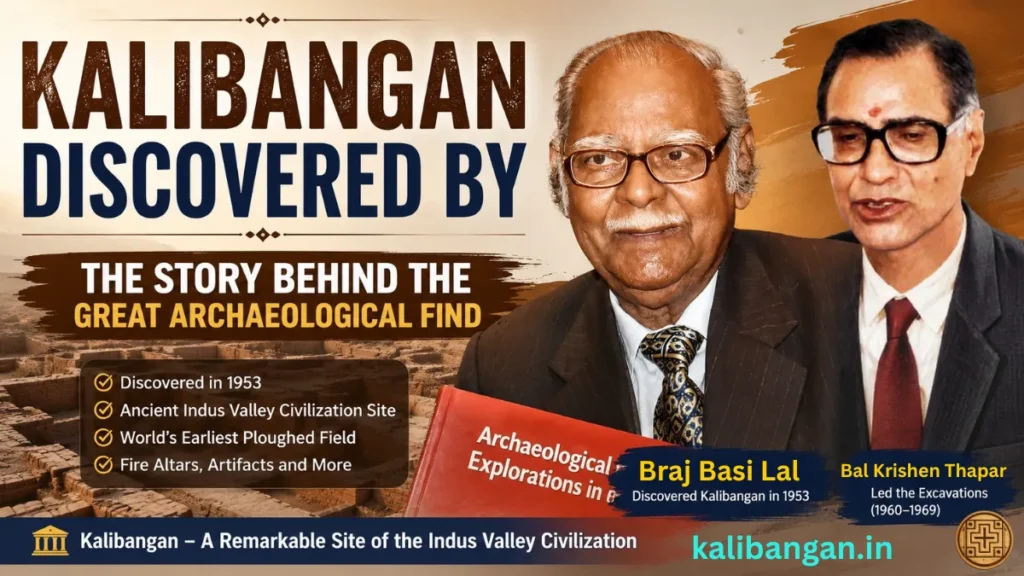
Kalibangan discovered by archaeologist Amalananda Ghosh, who played a major role in bringing one of India’s most important archaeological treasures to the attention of the world. Located in the Hanumangarh district of Rajasthan, Kalibangan is one of the most significant sites of the Indus Valley Civilization. The discovery of this ancient settlement provided valuable insights into urban planning, agriculture, culture, and daily life during one of the world’s earliest civilizations.
Today, Kalibangan stands as a remarkable historical site that helps historians understand the development of human civilization in the Indian subcontinent. Its unique features, including evidence of ploughed agricultural fields and well-planned urban structures, make it different from many other Harappan settlements.
Kalibangan Discovered By Whom?

The answer to the question “Kalibangan discovered by whom?” is Amalananda Ghosh. He discovered the site in 1953 during archaeological explorations in Rajasthan. At the time, researchers were actively searching for additional settlements connected to the Indus Valley Civilization following the discoveries of Harappa and Mohenjo-daro.
Amalananda Ghosh recognized the historical importance of the site and initiated further studies. His discovery eventually led to extensive excavations that revealed the site’s significance in understanding the Harappan culture.
The excavations at Kalibangan were later conducted under the leadership of renowned archaeologists including B. B. Lal and B. K. Thapar between 1960 and 1969. Their work uncovered numerous artifacts, structures, and evidence of ancient urban life.
What Is Kalibangan?
Kalibangan is an ancient archaeological site situated on the banks of the now-dry Ghaggar River, which many scholars associate with the ancient Saraswati River. The name “Kalibangan” means “black bangles,” a name derived from the large number of black-colored bangles found in the area.
The settlement was an important center of the Indus Valley Civilization, also known as the Harappan Civilization, which flourished between approximately 3300 BCE and 1300 BCE.
Kalibangan consists of two main parts:
- The Citadel or fortified upper town
- The Lower Town or residential area
These sections demonstrate advanced town planning and organized urban development.
Location of Kalibangan
Kalibangan is located in the Hanumangarh district of Rajasthan, India. It lies near the modern town of Pilibanga and close to the dry bed of the Ghaggar River.
Quick Facts About Kalibangan
| Feature | Details |
|---|---|
| Location | Hanumangarh District, Rajasthan |
| Discovery Year | 1953 |
| Kalibangan Discovered By | Amalananda Ghosh |
| Civilization | Indus Valley Civilization |
| Excavation Period | 1960–1969 |
| River Nearby | Ghaggar River |
| Famous For | Ploughed field, fire altars, urban planning |
| Historical Age | Around 2600–1900 BCE |
Historical Background of Kalibangan
Before the discovery of Kalibangan, much of the knowledge about the Indus Valley Civilization came from sites located in present-day Pakistan, such as Harappa and Mohenjo-daro.
The discovery of Kalibangan expanded the geographical understanding of the civilization and showed that Harappan culture extended deep into present-day India.
Researchers found evidence that Kalibangan had two major phases of occupation:
Pre-Harappan Phase
The earliest settlement belonged to the Pre-Harappan culture. During this phase, people lived in mud-brick houses and practiced agriculture.
The settlement was already fortified, indicating a developed community with social organization.
Harappan Phase
Later, Kalibangan became part of the mature Harappan Civilization. During this period, urban planning became more advanced, and the town developed into an important regional center.
The streets were arranged in a grid pattern, and houses were constructed according to a planned layout.
Why Is the Discovery of Kalibangan Important?
The fact that Kalibangan discovered by Amalananda Ghosh led to one of India’s greatest archaeological findings cannot be overstated.
The site provided evidence of:
- Early urban planning
- Agricultural practices
- Religious rituals
- Trade activities
- Social organization
- Craft production
These discoveries helped scholars better understand the development of civilization in South Asia.
The World’s Earliest Ploughed Field
One of the most remarkable discoveries at Kalibangan was an ancient ploughed agricultural field.
Archaeologists found clear furrow marks preserved in the soil. These marks showed a crisscross pattern used for farming.
This discovery is considered one of the earliest known examples of ploughed agriculture in the world.
The finding provided direct evidence that the inhabitants practiced organized farming thousands of years ago.
Significance of the Ploughed Field
The ancient field demonstrated that:
- Agriculture was highly developed.
- Farmers understood crop management.
- Irrigation and cultivation techniques existed.
- Food production supported urban populations.
This discovery greatly enhanced knowledge of early agricultural systems.
Urban Planning at Kalibangan
Kalibangan showcases the impressive urban planning skills of the Harappan people.
The city was carefully designed with:
- Straight roads
- Planned neighborhoods
- Drainage systems
- Fortified walls
- Public and residential spaces
The town layout reflects a sophisticated understanding of architecture and civic management.
Grid Pattern Streets
Like other Harappan cities, Kalibangan’s streets intersected at right angles.
This grid-based planning allowed for efficient movement and organization within the city.
Houses and Buildings
Most houses were built using mud bricks. Many homes contained:
- Courtyards
- Rooms for storage
- Kitchens
- Wells
The uniform construction style indicates adherence to common building standards.
Fire Altars Found at Kalibangan
Another unique feature discovered at Kalibangan was a series of fire altars.
Archaeologists uncovered several structures believed to have been used for ritualistic or religious purposes.
These fire altars distinguish Kalibangan from many other Harappan sites and provide clues about the spiritual beliefs of its inhabitants.
Religious Significance
The presence of fire altars suggests:
- Ritual ceremonies may have been performed.
- Fire held religious importance.
- Organized worship practices existed.
Although historians continue to debate their exact purpose, these structures remain among the most intriguing discoveries at the site.
Artifacts Found at Kalibangan
Excavations uncovered a wide variety of artifacts that reveal details about daily life.
Pottery
Numerous pottery items were discovered, including:
- Bowls
- Pots
- Storage jars
- Painted ceramics
Many pottery pieces displayed geometric designs and artistic patterns.
Tools and Implements
Archaeologists found:
- Copper tools
- Stone tools
- Agricultural implements
- Household objects
These artifacts demonstrate technological development and craftsmanship.
Ornaments
Residents used various decorative items such as:
- Bangles
- Beads
- Shell ornaments
- Terracotta jewelry
These objects indicate cultural sophistication and artistic expression.
Seals
Several seals similar to those found at Harappa and Mohenjo-daro were discovered.
These seals likely played a role in trade and administration.
Evidence of Trade and Economy
Kalibangan was not an isolated settlement.
The discovery of seals, pottery, and other artifacts suggests that it participated in trade networks connecting different regions of the Harappan world.
Trade may have included:
- Agricultural products
- Metal goods
- Beads
- Pottery
- Textiles
Such economic activities contributed to the prosperity of the settlement.
Why Was Kalibangan Abandoned?
One of the biggest mysteries surrounding Kalibangan is its abandonment.
Researchers have proposed several theories.
River Changes
Many scholars believe that changes in the course of the Ghaggar River affected water availability.
As the river gradually dried up, sustaining large populations became difficult.
Environmental Factors
Environmental changes may have reduced agricultural productivity and encouraged migration.
Natural Disasters
Some experts suggest earthquakes or other natural events could have contributed to the decline of the settlement.
While no single explanation has been universally accepted, environmental changes remain the most widely supported theory.
Kalibangan and the Saraswati River Debate
Kalibangan plays a central role in discussions about the ancient Saraswati River.
Many historians and geologists believe the Ghaggar River may represent the remnants of the Saraswati mentioned in ancient Indian texts.
Because Kalibangan lies along this river system, the site provides important evidence for studying ancient river networks and settlement patterns.
The debate continues, but Kalibangan remains a crucial archaeological location for understanding the relationship between rivers and early civilizations.
Comparison with Other Harappan Cities
Kalibangan shares many characteristics with other major Harappan cities but also possesses unique features.
| Site | Modern Location | Key Feature |
|---|---|---|
| Harappa | Pakistan | First discovered Harappan city |
| Mohenjo-daro | Pakistan | Advanced drainage system |
| Dholavira | Gujarat, India | Water conservation system |
| Lothal | Gujarat, India | Ancient dockyard |
| Kalibangan | Rajasthan, India | Ploughed field and fire altars |
This comparison highlights the diversity and sophistication of the Indus Valley Civilization.
Also read: Archaeological Museum Kalibangan: Timings, Ticket Price, Harappan History & Visitor Guide
Archaeological Museum at Kalibangan
Visitors to Kalibangan can explore a museum that houses many artifacts recovered during excavations.
The museum displays:
- Pottery
- Tools
- Seals
- Terracotta objects
- Ornaments
These exhibits help visitors understand the cultural and historical significance of the site.
Lessons from Kalibangan
The discovery of Kalibangan teaches several important lessons about ancient societies.
The people of Kalibangan demonstrated:
- Advanced planning skills
- Agricultural innovation
- Architectural knowledge
- Cultural development
- Trade organization
Their achievements reveal that urban civilization in South Asia flourished thousands of years ago.
Also read: History of Kalibangan: Exploring Rajasthan’s Ancient Harappan Civilization
Conclusion
The story of kalibangan discovered by Amalananda Ghosh is an important chapter in Indian archaeology. His discovery in 1953 opened the door to remarkable findings that transformed our understanding of the Indus Valley Civilization. From the world’s earliest known ploughed field to unique fire altars and carefully planned streets, Kalibangan provides invaluable evidence of an advanced ancient society.
Today, Kalibangan remains one of India’s most significant archaeological sites. Its discoveries continue to help historians, archaeologists, and researchers uncover the rich heritage of one of humanity’s earliest urban civilizations. The site stands as a powerful reminder of the ingenuity, creativity, and resilience of the people who lived there thousands of years ago.